
Key Takeaways
- The core bottleneck: Manual data entry and cross-platform tie-outs consume 40+ hours per accountant monthly during month-end close.
- The failure of spreadsheets: Manual VLOOKUPs break under transaction volume, introducing formula corruption, late-night reconciliation stress, and FTA corporate tax audit risks.
- The deterministic alternative: Deploying custom, lightweight reconciliation bridges connects existing bank feeds and accounting software in 10 business days.
Quick audit: Does your team spend more than 4 business days closing the monthly books? If yes, your manual workflows are leaking productive capacity and obscuring cash visibility.
The Operational Reality: Why Month-End Drags Out Across UAE Finance Teams
For most mid-market finance teams operating across Dubai and Abu Dhabi, the final week of the calendar month is not spent analyzing margins or guiding capital allocation. It is consumed by the month-end crunch: an exhaustive, high-friction sprint through disjointed bank portals, billing extracts, point-of-sale data, and accounting ledgers.
Consider a typical UAE mid-market enterprise handling AED 3,500,000 to AED 15,000,000 in monthly turnover. Transaction data does not arrive neatly categorized. Instead, transaction records reside across multiple disparate touchpoints: corporate accounts across Emirates NBD, First Abu Dhabi Bank (FAB), and Abu Dhabi Commercial Bank (ADCB); merchant gateway settlement batches from Stripe and Network International; multi-currency supplier invoices in AED, USD, and EUR; and payroll records tied to Wage Protection System (WPS) compliance.
To bridge these disjointed data streams, finance departments default to manual spreadsheet tie-outs. Qualified accountants spend 40 or more hours every month copying raw transaction extracts into monolithic, 14-tab reconciliation workbooks. They run fragile VLOOKUP, INDEX/MATCH, and XLOOKUP formulas, hunt down unbilled revenue leaks, and manually adjust cross-border exchange variances.
When a single formula breaks or a supplier invoice is duplicated, the entire ledger halts. Senior accountants remain in the office past 11 PM chasing a 2-fils variance across 1,800 rows. By the time the balance sheet is finalized and P&L statements reach the executive committee on the 10th or 12th business day, the financial intelligence is already stale.
The Hidden Compliance Liability Under UAE Corporate Tax
Before the introduction of the UAE Federal Corporate Tax regime at a statutory rate of 9%, spreadsheet drift was treated as an internal annoyance. Today, it represents a direct regulatory and statutory compliance liability.
Under Federal Tax Authority (FTA) audit scrutiny, financial statements cannot rely on opaque, overwritten spreadsheet cells. Auditors require a verifiable, unbroken audit trail from source documentation to the general ledger. Spreadsheets inherently lack deterministic immutability: cells can be accidentally overwritten, macro scripts can silently fail, and historical transaction logs can be lost without version tracking.
Relying on manual spreadsheets to support 9% Corporate Tax returns, split VAT allocations, and WPS payroll proration introduces severe exposure to penalties. What finance leaders need is not more accounting hours, but rule-based ledger pipelines that execute with mathematical certainty.
Technical Breakdown: Spreadsheets vs. Enterprise ERP vs. Smart Systems
When financial controllers recognize that manual spreadsheets cannot scale, they are often told they face a binary choice: either hire more junior accountants to maintain fragile workbooks, or purchase a multi-million-dirham enterprise ERP overhaul.
Both approaches are fundamentally flawed. Adding accountants increases coordination drag and compounds human error. Enterprise ERP implementations require 6 to 9 months of painful disruption, budget overruns exceeding AED 350,000, and comprehensive company-wide retraining, only for teams to export data back into Excel anyway.
There is a pragmatic, high-velocity third way: the Zaleo Smart Automation Layer.
| Operational Metric | Manual Spreadsheets (Excel) | 6-Month Enterprise ERP Overhaul | Zaleo Smart Automation Layer |
|---|---|---|---|
| Deployment Timeline | Instant (but degrades over time) | 6 to 9 months | Weeks, not months |
| Capital Investment | Low upfront / High hidden labor cost | AED 200,000 – AED 500,000+ | Fixed-scope project, no ERP license |
| Operational Disruption | Zero initially / Constant daily friction | High (requires company-wide retraining) | None; sits on your existing software |
| Reconciliation Accuracy | High human error & formula corruption | Rule-based (but rigid) | Rule-based, with exceptions flagged for review |
| Audit Trail (FTA/Tax) | Poor (overwritten cells, no logs) | Complex database logs | Immutable log of every match |
| Close Cycle Velocity | 10 to 14 business days | 5 to 7 business days | 48 hours |
| Team Bandwidth Reclaimed | 0 hours (consumes 40+ hrs/month) | 15–20 hours/month | 40+ hours/month |
Rather than ripping out your existing accounting software (such as Xero, QuickBooks, Zoho Books, or NetSuite), a smart automation layer sits non-disruptively directly atop your current stack. It ingests transactional data from bank feeds, billing engines, and payment gateways, matches entries mathematically, and synchronizes clean journal entries straight into your chart of accounts.
The 4-Step Playbook: Compressing the Close to 48 Hours
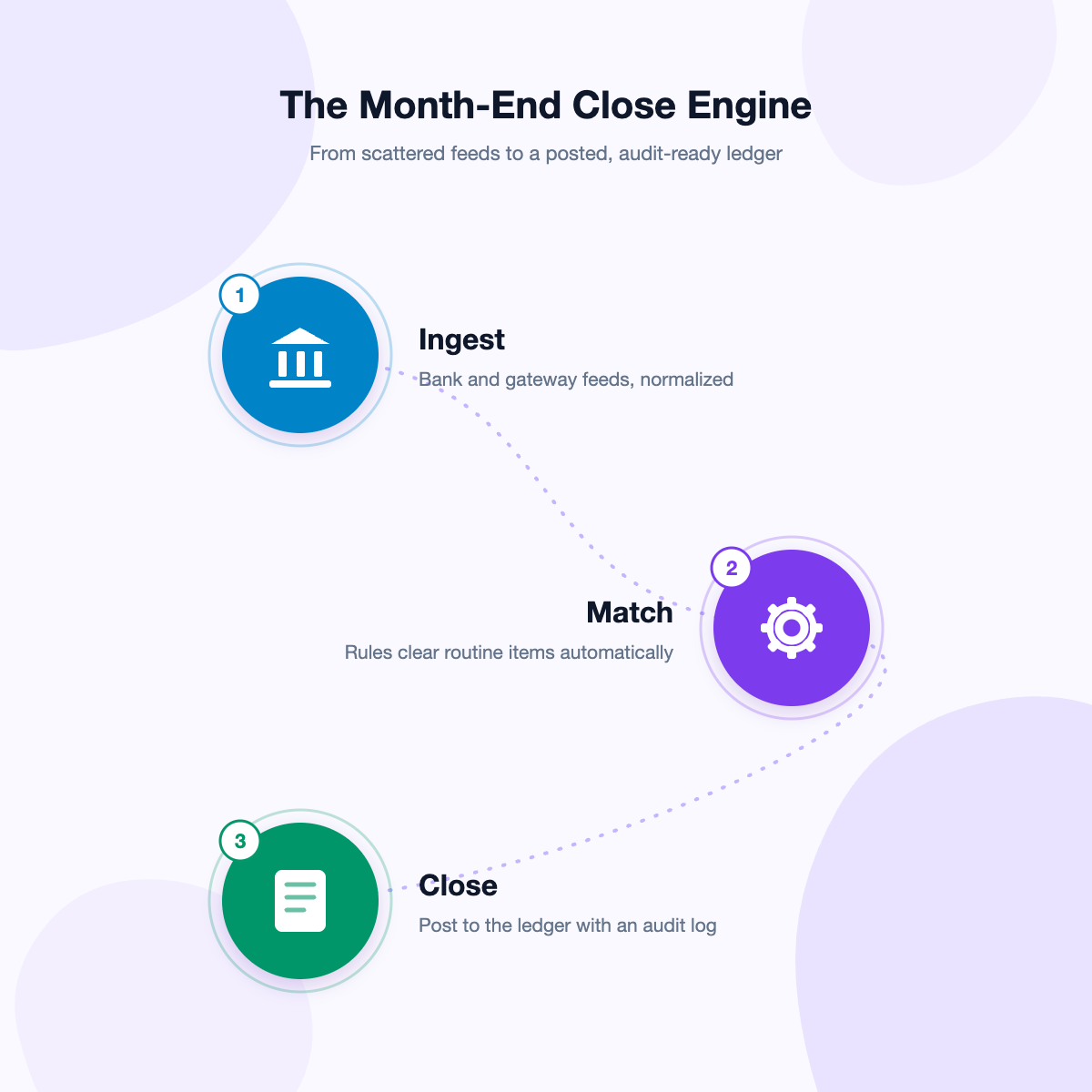
To reduce the close cycle from 10 days to 48 hours without operational chaos, UAE finance teams must implement a structured, four-step deterministic workflow:
Step 1: Master Schema Clean-Up & Normalization
Reconciliation failures almost always stem from dirty, non-standardized master data. Supplier names appear inconsistently across bank memos (e.g., "ENBD/AMZN PAYMENTS", "AMAZON COMMERCIAL", "AMZN WEB SERVICES"), preventing direct matching. The first stage standardizes all transaction entities, maps vendor and customer Tax Registration Numbers (TRNs), and normalizes currency codes and date conventions into a uniform schema before reconciliation begins.
Step 2: Rule-Based Automated Matching (2-Way & 3-Way)
Instead of manual cross-referencing, deploy an automated matching bridge operating on deterministic mathematical rules. The engine executes:
- 2-Way Matching: Reconciling bank statement credit entries against open accounts receivable (AR) invoices, settlement references, and payment gateway payouts.
- 3-Way Matching: Verifying purchase orders (POs), supplier invoices, and bank debit transactions, automatically cross-checking line-item totals, VAT amounts, and withholding deductions.
By executing thousands of transactions in seconds, 95% to 98% of all standard transactions clear instantly with zero human intervention.
Step 3: Exception-Only Review Routing
In a manual close, accountants inspect 100% of transactions to find the 3% that contain errors. A modern automation pipeline flips this paradigm entirely: the system processes all matched transactions automatically and routes only genuine exceptions (such as bank fee deductions, unidentified deposits, or partial payments) to a streamlined review inbox. Finance professionals spend 30 minutes resolving genuine discrepancies rather than 3 days scrolling through matched records.
Step 4: Continuous Ledger Synchronization & Audit Logging
The final phase synchronizes verified entries directly into your general ledger via API, generating balanced journal entries with attached source references and timestamps. Every transaction retains an immutable digital audit log detailing the matching rule applied, timestamp, and source document identifier, providing instant, audit-ready verification for FTA tax inspections and annual statutory audits.
Stop Losing 40+ Hours Every Month-End to Manual Spreadsheets.
Uncover hidden ledger leaks, formula discrepancies, and close bottlenecks with zero software disruption.
Conclusion: Reclaiming Finance as a Strategic Growth Driver
Closing the monthly books in 48 hours is not a luxury reserved for multinational conglomerates. Mid-market enterprises in the UAE can achieve rapid, audit-ready financial close cycles by substituting fragile manual spreadsheets with deterministic automation layers.
When your accounting team is liberated from the mechanics of manual data entry, month-end ceases to be an operational fire drill. Your finance leadership reclaims over 40 hours every month to focus on forward-looking cash flow forecasting, margin optimization, and strategic enterprise growth.