Executive Summary
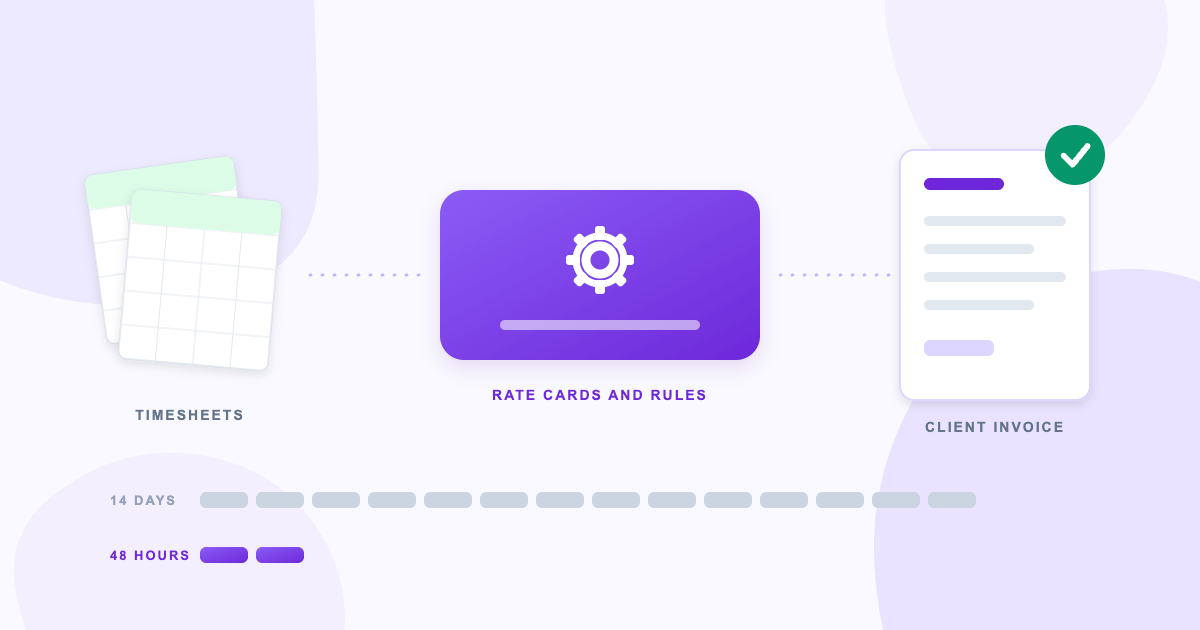
- The core bottleneck: UAE recruitment and manpower agencies can lose up to 14 business days every month reconciling approved contractor timesheets against client rate cards before generating invoices.
- The working capital drain: This billing lag ties up AED 800,000 to AED 2,500,000 in unbilled payroll outlays, forcing agencies to fund Wage Protection System (WPS) disbursements weeks before client payments arrive.
- The spreadsheet breakdown: Nested VLOOKUPs drop overtime differentials, misapply mainland versus designated free zone VAT treatment, and create manual errors that trigger client invoice disputes.
- The deterministic alternative: A custom automation bridge on top of your existing timesheet portals and accounting software can compress billing turnaround from 14 days to under 48 hours.
Quick diagnostic: Does your staffing agency take more than 5 business days after month-end timesheet cutoff to deliver final, undisputed client invoices? If yes, your manual billing process is leaking contractor margin and constraining cash flow.
The Operational Reality: Why Staffing Agencies Drown in Billing Delays
In the UAE staffing, recruitment and workforce outsourcing sectors, billing speed is tied directly to cash. Consider an agency deploying 350 contingent IT, engineering or hospitality contractors across Dubai and Abu Dhabi, generating AED 4,500,000 in monthly billing. As soon as timesheets close on the last day of the month, the finance team enters a two-week bottleneck.
Unlike standard corporate accounting, workforce staffing billing is dynamic:
- Standard billable hours versus weekend overtime multipliers (1.25x versus 1.5x)
- Contractor gross margins that shift with milestone volume
- Public holiday shift premiums under UAE Labour Law
- Prorated WPS gross-to-net payroll deductions
- Split VAT treatment: 5% standard rate for mainland entities versus out-of-scope or exempt treatment for designated free zones
To reconcile these variables, billing teams export raw CSV hours from timesheet portals into large master Excel workbooks. An accountant then spends 8 to 12 days cross-referencing hours against rate cards, calculating margins, typing invoice drafts and formatting payment schedules.
When an error slips through, such as an overtime miscalculation on an AED 140 per hour contractor, the client rejects the entire AED 120,000 invoice. The payment cycle resets, and Days Sales Outstanding (DSO) stretches past 60 or 90 days.
The Working Capital Trap: Funding WPS While Client Invoices Wait
Under UAE Ministry of Human Resources and Emiratisation (MOHRE) rules, contractor salaries must be paid through the Wage Protection System within statutory deadlines, whether or not client invoices have been settled. When timesheet-to-invoice reconciliation takes 14 days, the cash timeline looks like this:
- Days 1 to 5: The agency pays AED 1.8M in contractor wages through WPS to avoid labour penalties and file rejections.
- Days 5 to 14: The finance team is tied up in manual Excel tie-outs, preparing client billing.
- Day 15: Client invoices are finally issued.
- Days 45 to 60: The client settles under standard credit terms.
The agency is effectively acting as a short-term bank for its clients, absorbing hundreds of thousands of dirhams in working capital drag. Every day taken out of the timesheet-to-invoice cycle returns liquidity to the agency’s operating accounts.
Technical Breakdown: Solution Architecture Comparison
| Operational Metric | Manual Spreadsheets (Excel) | Enterprise Recruitment ERP | Zaleo Automation Bridge |
|---|---|---|---|
| Deployment Timeline | Instant (degrades under volume) | 6 to 9 months | About two weeks |
| Capital Investment | Low upfront, high operational labor | AED 250,000 to AED 600,000+ | Transparent, fixed-investment sprint |
| Operational Disruption | High daily friction and fatigue | High (extensive recruiter retraining) | None: sits on top of existing portals and ledgers |
| Overtime and Margin Accuracy | Frequent formula drift (#REF! and overrides) | Rule-based, but rigid customization | Deterministic, rule-based matching |
| Billing Velocity | 10 to 14 business days | 4 to 6 business days | 24 to 48 hours from timesheet cutoff |
| UAE Compliance Support | Manual WPS and split-VAT checks | Generic localization modules | Built-in WPS SIF and FTA VAT rules |
| Cash Acceleration (DSO) | Lagging (60 to 75+ days) | Moderate (45 to 55 days) | Accelerated by 12 to 15 business days |
The 4-Step Playbook: Compressing Staffing Billing to 48 Hours
To remove billing lag for good, forward-looking UAE staffing agencies build a deterministic data pipeline that connects timesheet capture directly to invoice generation.
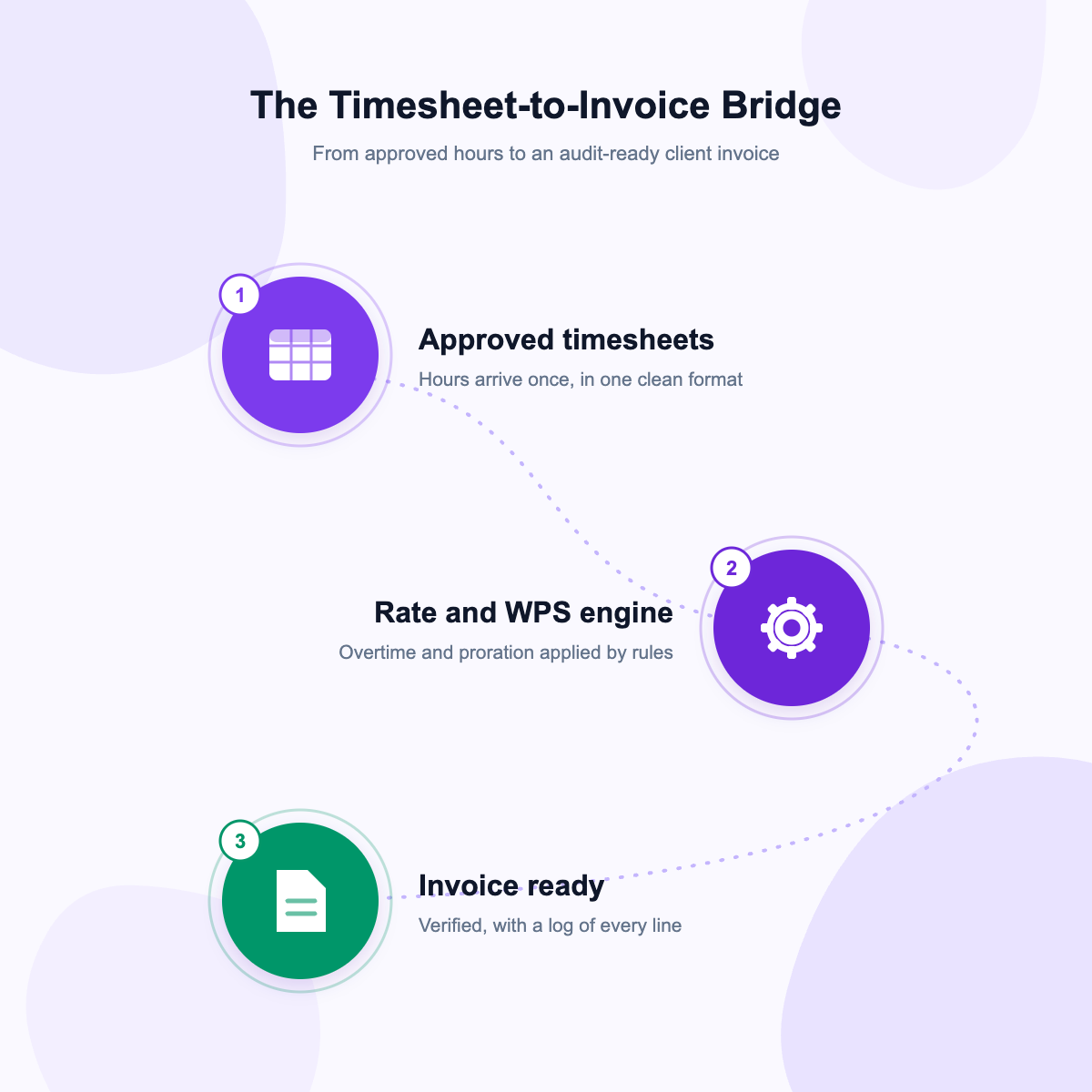
Step 1: Timesheet schema ingestion and rate card normalization
The automation layer ingests approved timesheet extracts from candidate portals or VMS systems, normalizes role titles and maps hours directly to pre-configured rate cards.
Step 2: Rule-based margin and WPS calculation engine
A deterministic engine evaluates regular hours, overtime tiers and weekend allowances in milliseconds, computing gross payout, WPS salary alignment and agency margin.
Step 3: Automated client invoice generation and split-VAT routing
The system compiles verified contractor records into client-ready invoice drafts, attaches timesheet backups and applies mainland (5%) versus free zone VAT logic.
Step 4: Continuous ledger synchronization and audit logging
Invoices push through API into Xero, QuickBooks, Zoho or NetSuite, while a validated WPS SIF file is generated for bank submission with a full audit trail.
Stop Financing Your Clients’ Payroll Out of Working Capital.
Uncover billing leaks, automate complex contractor rate cards, and compress your timesheet-to-invoice cycle from 14 days to 48 hours.
Conclusion: Turning Billing Velocity into a Competitive Advantage
In recruitment and staffing, operational speed is commercial leverage. Agencies that deliver clean, auditable invoices within 48 hours of timesheet approval accelerate collections, reduce billing disputes and protect contractor margin.
By adding a lightweight, deterministic automation bridge on top of existing software, UAE staffing agencies can scale contractor placements without adding administrative overhead.